
All jokes are fair game, except for one: rape, at least for now.
so similar yet very different: rape jokes and kidnapping jokes

Background
This tweet/question is what inspired this write up.
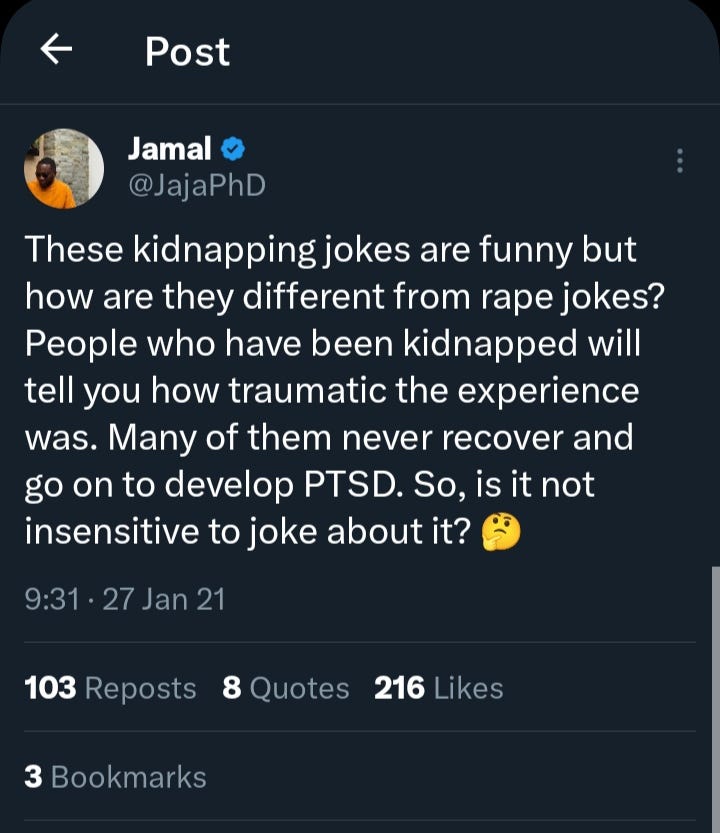
Why am I doing this?

This might be coming three years late but as they say it's really never too late. My then Khalifah/Zyk not the now Emeka, saw this tweet/question almost 3 years ago. The link to the tweet Curiosity led me to explore the quotes and replies, seeking an answer that resonated with my biases and opinions. However, the majority of responses fell short. This rea…
here
Introduction
Humor, in its true essence, serves as a means to revisit our best and worst moments without the anxiety and fears that accompanied them. It provides a unique avenue for testing the limits of societal norms, opening us to ideas deemed absurd or radical in conventional contexts. Acting as a glue, humor binds extreme and mainstream thoughts, presenting them outside the confines of societal standards. This boundary-testing phenomenon has sparked controversy numerous times.
While I acknowledge the significance of humor in our social interactions, I firmly advocate that there should be no boundaries to comedy, as long as it is clearly defined, and the audience is aware of its humorous nature—except when it comes to rape jokes. This exception, though thought-provoking and controversial, remains relevant and necessary, making it the focal point of this article.
Comedy demands precise definitions, and audiences must always be informed. In instances where offense is taken, comedians carry the responsibility to clarify their intentions without issuing apologies if they are not at fault but rather misunderstood. The aim is not a simple apology but ensuring clarity that the context is rooted in humor and nothing more. Inappropriate jokes, though deemed unacceptable in certain situations, should not categorically render a topic off-limits for comedy. Even sensitive or controversial subjects, like rape, can and should be approached humorously when appropriate. Unfortunately, the current reality dictates that, for now, rape jokes remain inappropriate. Using a specific tweet as a focal point, I will delve into why rape jokes differ from kidnapping jokes and why it's acceptable to jest about one but not the other, despite apparent similarities that are still very different and realities apart.
The levels of accountability that comedians should uphold are often a subject of debate, questioning what is deemed acceptable or not in the realm of comedy. Comedians, like other artists, enjoy liberty and freedom of expression. However, the ever-expanding nature of media has made the works of many comedians overlap with traditional news and social commentators, seen through the lens of various media commentators and newsroom journalists. Despite the broad range, audience, and practice, there seems to be a lack of clear responsibility and ethics governing them. In this era of social media, where social commentary is open, broad, and accessible to almost everyone, including anonymous individuals, the responsibility of individuals, along with the consideration of free speech, becomes notably relaxed and almost negligible.
In the spirit of live, learn, and laugh, comedy, when done well, allows us to momentarily set aside boundaries and subject ourselves to shared experiences. For this reason, comedy should encompass all aspects of life, offering everyone the chance to experience freedom and shared laughter, without any group of humans being exempted. Artists should always strive to entertain and connect with everyone. A well-executed comedy should make us laugh at our worst memories, enable us to relate to or empathize with realities we have or haven't lived, question what we thought was unquestionable, and appreciate things we may not have had a chance to contemplate before.
This article treats jokes and tweets as works of art created by comedians rather than the creations of relatively unknown individuals. Controversies surrounding comedy often center on freedom of speech, truth-telling, non-maleficence, order, cohesion, equality, and human dignity, with opinions varying widely.
Jokes about sensitive issues
Exploring the realm of humor on sensitive subjects sparks ongoing debates, with varying perspectives on the permissible boundaries, appropriate topics, and the delicate navigation of sensitive issues. In my view, jokes should have no limitations, irrespective of their perceived sensitivity. Once the topic is established, and the audience is informed, jokes should be embraced. These moments offer a unique opportunity to shed light on harsh realities, fostering a shared experience free from societal constraints. Executed responsibly within the defined scope of a comedian's responsibilities, such humor can foster connection with diverse perspectives and gently introduce unconventional ideas. While opinions on this responsibility may differ, clarity and a non-malicious approach are paramount.
Humor, as a tool, can address suppressed emotions and traumas associated with various events. Despite the inclination to forget, addressing and managing these emotions is crucial. Humorous takes on challenging topics can serve as a means to gently guide individuals toward confronting these events. In the context of free speech, jokes epitomize the protection these laws aim to provide. Offense, in this scenario, falls upon the individual, excluding the grave exception of rape due to its nature and the current societal landscape.
Similar but so different
Drawing parallels between rape and kidnapping reveals both as egregious crimes against the weak and vulnerable, violating individual rights and personal autonomy, often leading to enduring trauma and, tragically, death. The intertwined nature of kidnapping and rape further compounds the associated anguish, as many kidnapped victims also experience sexual assault. However, treating jokes about these two crimes equally is not straightforward, as the distinctions between them become apparent beyond their initial similarities.
The sharp contrast between rape and kidnapping begins with the crimes and the evidence themselves, as well as the accompanying circumstances. Kidnapping is often evident; in most cases, kidnappers even contact victims' families to demand ransom. One typically needs to go missing and be reported for kidnapping to occur—a crime that many people, aside from the victim, become aware of as it unfolds. This is not the case with rape. Only in very rare instances is there distinct evidence of rape, unless the perpetrators confess, which is itself uncommon. The challenge lies in the victim's word against the perpetrator's, intensifying the emotional burden. Many times, rape victims barely come forward to report the crime or share their experience with others, because what purpose does it serve for them in our current society? There often isn't conclusive evidence for many who doubt the occurrence of the crime; it becomes a matter of the victim's word against the perpetrator's, adding to the tragedy. While many actively attempt to discredit her account and continuously question its credibility, this persists alongside the stereotypes and discrimination that victims encounter in numerous societies.
Then, going about the prosecution of these two crimes is an even sharper contrast; the success rate of one is almost inverse of the other, with a very low rate for rape cases. So, while kidnap victims are sympathized with, their captors condemned, and their release celebrated by everyone, they go on to get justice for victims when they're captured. Their perpetrators are mostly strangers to the victims, and even when they're not, they don't get to see them again. It's almost the reverse for rape victims; they find it hard to come outside and report or speak about the crime. When they do, they're doubted by many, even close family members, get victim-blamed, and face stereotypes. While the perpetrators are mostly known and familiar to the victims, the cases most times are mostly settled out of court. They get to see, and even sometimes continue to live with, their perpetrators, and almost every time, they don't get justice.
With this clear distinction, it becomes evident why and how both crimes differ, making it easy to joke about one but not the other. Kidnap victims often hear jokes about their experiences and can laugh about them, even if they've endured trauma. They find solace in the support of those around them, the sympathy they receive, and the pursuit of justice against their perpetrators. In this supportive environment, victims can humorously reflect on their past, conquering the previous fear and feeling victorious or safe. However, this is not the reality for rape victims. It's challenging to find humor in a current pain that is actively dismissed, downplayed, and blamed upon them, while their perpetrators, in most cases, roam freely without facing justice. It's difficult to see this situation as non-malicious, not directed at the comedian but rather at the society that is failing rape victims. Making jokes about rape itself is not the issue, but in the current societal context, it is inappropriate until rape victims receive the same treatment as kidnapping victims.
Just to point out, this isn't the same issue as jokes about LGBTQIA+ issues; it's perfectly acceptable to joke about those. However, delving into this topic is beyond the scope of today's discussion and might be better suited for a future article, possibly presented in a humorous manner.